
Published on June 15, 2026
Last updated on July 20, 2026
As container runtimes on macOS evolve, developers are constantly seeking the right balance between performance, resource efficiency, and native integration. Recently, we’ve put OrbStack and Apple Containers to the test using a robust criterion benchmark suite in Rust.
(Note: You can view the full benchmark project, documentation, and raw data at https://fermeridamagni.localhost/container-benchmarks/)
Here is a deep dive into how they compare across various metrics.
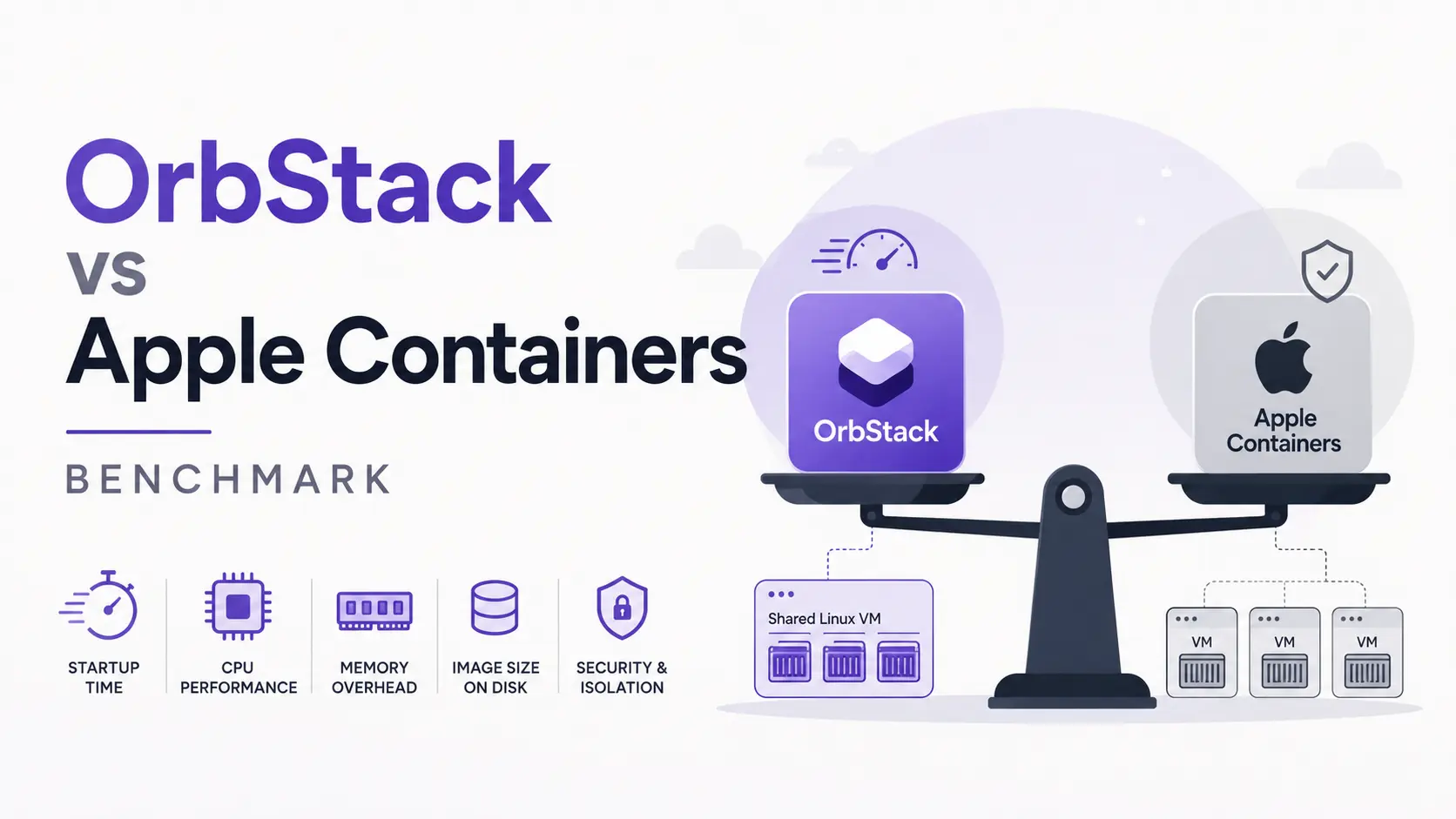
One of the most noticeable metrics for local development is how fast a container can boot, execute a command, and terminate. Apple Containers launch a dedicated micro-VM per container—a great feature for isolation but with a slight overhead compared to OrbStack, which shares a highly optimized Linux VM.
OrbStack consistently starts containers in roughly half the time compared to Apple Containers, making it incredibly snappy for rapid test-and-run cycles.
Running sysbench cpu run inside the containers shows that both solutions achieve near-native performance. This is primarily because both heavily rely on Apple’s Virtualization framework to tap directly into Apple Silicon’s processing power.
The CPU performance is effectively a tie. Both runtimes allow your containers to utilize the underlying hardware with minimal virtualization penalty.
Memory consumption is where the architectural differences become obvious. Apple Containers consume a baseline of RAM for each dedicated VM instance. OrbStack, leveraging its shared VM model, runs additional containers with significantly lower base memory overhead.
For heavy multitasking or running many microservices locally, OrbStack’s shared-VM approach will save substantial amounts of RAM.
Both runtimes are OCI-compliant and pull the same images. The underlying storage mechanism on macOS can impact how much space they ultimately take on your SSD.
Both runtimes are highly efficient. Apple Containers matches OrbStack’s footprint nicely, as both utilize APFS native features like clones and sparse files optimally.
When choosing a local container runtime, performance is only half the equation. The underlying architecture and how it isolates containers from the host macOS system is critical, especially when running untrusted or unverified code.
OrbStack: The Shared-Kernel Micro-VM Like many traditional developer-focused container tools on macOS, OrbStack utilizes a highly-optimized Linux micro-VM.
Apple Containers: One-VM-Per-Container Introduced with native Virtualization framework enhancements, Apple’s approach fundamentally changes the container model on macOS.
In a shared-kernel architecture like OrbStack, a vulnerability in the Linux kernel or a container escape exploit can potentially compromise the entire shared VM, affecting all other running containers. Because of this, OrbStack explicitly notes that its default setup is not a substitute for a full VM when dealing with actively malicious code.
By contrast, Apple Containers’ hypervisor-level isolation completely prevents traditional namespace-based container escapes. Even if an attacker compromises a container, they are trapped within that specific micro-VM, unable to access the host macOS or other adjacent containers.
Both OrbStack and Apple Containers are fantastic tools built on modern macOS frameworks.
Ultimately, Apple’s virtualization framework proves to be exceptionally powerful regardless of which runtime orchestrates it. For most developer workflows, however, OrbStack currently takes the crown for its pure efficiency and speed.